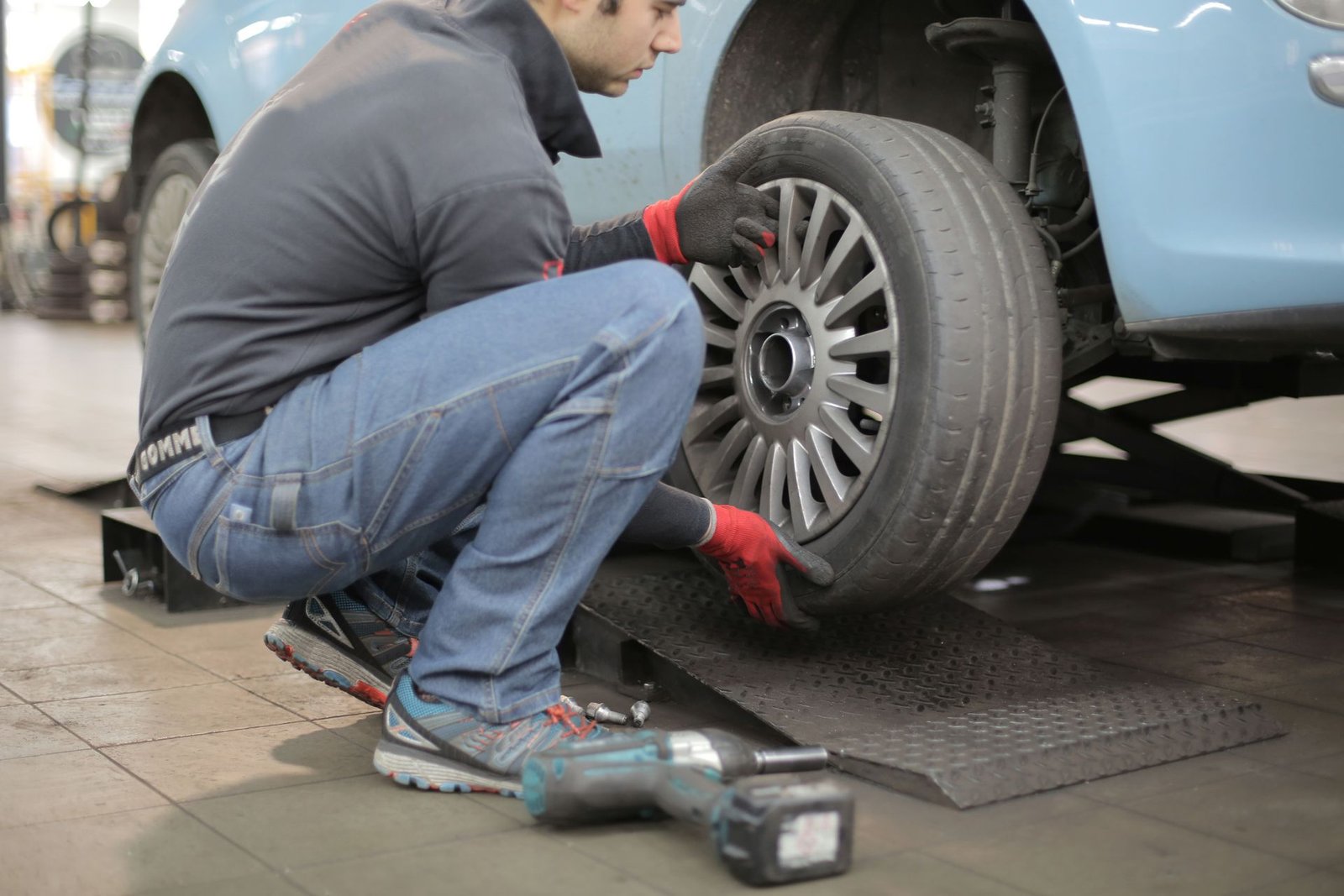
Whether you're on a US highway shoulder or in a parking lot, changing a tire is a skill every driver should know. It takes 15–30 minutes and saves you a $75–$150 roadside assistance call.
But tire changes are also one of the most dangerous DIY car tasks — a jack that slips, or a car that rolls off, can cause serious injury. Follow these steps exactly and the process is safe.
Before You Start
Confirm these before you begin:
- You have a spare tire and jack. Check your trunk. Many modern US cars (especially EVs and hybrids) come with a tire sealant kit instead.
- You're on a flat, hard surface. Dirt, gravel, or soft asphalt can cause the jack to slip. If possible, move to a parking lot or gas station.
- You're visible. Turn on hazard lights. If you have road flares or reflective triangles, set them out 50–100 feet behind your car.
- You're wearing gloves and safety glasses. Brake dust and rust flakes are common hazards.
Roadside Safety on US Highways
Changing a tire on a US highway shoulder is genuinely dangerous — dozens of US drivers are killed each year in roadside incidents. Take these precautions:
- Get as far off the road as possible. If there's a guardrail, stay outside of it while working if you can access the tire from there.
- Turn on hazard lights immediately. This is required by law in most US states when stopped on a shoulder.
- Set out reflective triangles at 50, 100, and 150 feet behind your car (if you have them).
- Wear a high-visibility vest if you have one. US highway shoulders are dark and cars pass at 70+ MPH.
- If the traffic is heavy or the shoulder is narrow, call for help. AAA, insurance roadside, and apps like Urgently can reach you within 30–60 minutes. Your life is worth more than a $100 tow.
Step 1: Pull Over Safely and Turn On Hazards
- Slow down gradually. Do not brake hard.
- Signal and move to the far-right shoulder or the nearest safe location (parking lot, side street).
- Turn on your hazard lights immediately.
- Set the parking brake firmly.
- Put the transmission in Park (automatic) or 1st or Reverse (manual).
- Turn off the engine and remove the key.
Step 2: Gather Your Tools and Set Up Safety
In the trunk (usually under the cargo floor), you should find:
- The spare tire (full-size or donut)
- The jack (usually a scissor jack)
- The lug wrench (usually an L-shaped 4-way)
- Sometimes a locking lug nut key — check the glove box
Set out reflective triangles if you have them. Put on gloves and safety glasses.
Step 3: Loosen the Lug Nuts BEFORE Jacking
This is the single most important step most first-timers get wrong. Loosen the lug nuts while the tire is still on the ground. Once the car is jacked up, the wheel will just spin when you try to turn the wrench.
- Fit the lug wrench onto each lug nut.
- Turn counterclockwise (lefty-loosey) to break each nut loose.
- Loosen each nut by about a quarter turn — do NOT remove them yet.
- If a lug nut is stuck, use your body weight on the wrench or a cheater bar (a pipe slipped over the wrench handle).
Step 4: Place Wheel Chocks and Raise the Car
Before jacking, place wheel chocks (or rocks, bricks, or a piece of wood) on the wheel diagonally opposite the flat. This stops the car from rolling while you work.
Then locate the correct jack point. This is usually a reinforced section of the frame, 6–12 inches behind the front wheel or in front of the rear wheel. Check your owner's manual — using the wrong spot can crush your car's body panels.
- Position the jack under the correct jack point.
- Turn the jack handle clockwise to raise the car.
- Raise it until the flat tire is 1–2 inches off the ground.
- Give the car a gentle shake — it should feel stable. If it wobbles, lower it and reposition the jack.
Step 5: Remove the Lug Nuts and Flat Tire
- Fully remove all lug nuts and set them aside in a cup or pocket — they roll away easily.
- Grip the tire with both hands and pull it straight toward you, off the hub.
- Set the flat tire flat on the ground (so it doesn't roll).
If the tire is stuck to the hub (common on cars that haven't had a tire change in years), strike the tire's sidewall with your hand or the heel of your shoe to break it loose.
Step 6: Mount the Spare Tire
- Lift the spare tire up and align its lug holes with the wheel studs.
- Push it firmly against the hub until it seats.
- Hold the tire in place with one hand and thread one lug nut on with the other.
- Thread the rest of the lug nuts by hand until they're snug — do NOT tighten yet.
Step 7: Hand-Tighten the Lug Nuts in a STAR Pattern
This is critical. Lug nuts must be tightened in a star (criss-cross) pattern, not in a circle. Tightening in a circle can warp the brake rotor and cause vibration.
- Start with the top lug nut.
- Skip one and tighten the next one clockwise.
- Skip one back and tighten the next one.
- Continue until all 5 are snug — like drawing a star.
Step 8: Lower the Car and Fully Tighten the Lug Nuts
- Lower the jack completely until the tire is back on the ground.
- Remove the jack.
- Use the lug wrench to fully tighten the lug nuts, again in a star pattern.
- Tighten firmly — you shouldn't be able to loosen them by hand. But do NOT jump on the wrench or use a cheater bar for this final tightening — you can snap a stud.
Step 9: Check Tire Pressure and Stow the Flat
- Drive to the nearest gas station and check the spare's tire pressure.
- Fill it to the pressure listed on the spare tire itself (usually 60 PSI for donuts).
- Put the flat tire, jack, and lug wrench back in the trunk.
- Re-check the lug nuts within 50 miles — new installations can loosen slightly.
If the flat tire was damaged (nail, screw, cut), it may be repairable for $20–$40 at a US tire shop. If the sidewall is damaged, it can't be repaired — you'll need a new tire. For related DIY guidance, see our tire pressure guide.
Donut Spare Tire Rules (US)
Most US cars come with a temporary "donut" spare. These are NOT full-size tires — they have strict limits:
| Limit | Typical Rating |
|---|---|
| Maximum speed | 50 MPH |
| Maximum distance | 50 – 70 miles |
| Tire pressure | 60 PSI (do NOT inflate to normal car pressure) |
| Driving surface | Dry pavement only — no snow, ice, or gravel |
5 Mistakes That Can Cause Serious Injury
- Loosening lug nuts AFTER jacking. The wheel spins. Always break lug nuts loose while the tire is still on the ground.
- Using the wrong jack point. Jacking on the body panel or plastic trim crushes the car and can cause the jack to slip. Check your owner's manual.
- Getting under the car with only the jack. Jacks fail. If the car falls on you, you can be crushed or killed. Always use a jack stand if you need to go under.
- Tightening lug nuts in a circle. Warps the rotor and causes vibration. Always use a star pattern.
- Driving on a donut at highway speed. Donuts are rated for 50 MPH. Driving at 70+ MPH can blow them out — and they offer much less grip in emergency braking.
What If Your Car Doesn't Have a Spare Tire?
Many modern US vehicles — especially EVs (Tesla, Rivian, Lucid), hybrids, and some sports cars — don't come with a spare. Instead, they have:
- A tire sealant kit + inflator. This injects a sealant into the tire and inflates it — but it only works for small punctures in the tread. It does NOT work on sidewall damage or blowouts.
- Run-flat tires. These can be driven 50 miles at 50 MPH even when completely flat. But they're expensive ($250–$400 each) and can't be repaired after a puncture.
If your tire is severely damaged and you have no spare, call for help:
| Roadside Service | US Cost | Notes |
|---|---|---|
| AAA | Free with membership | $60–$130/year. Best value if you use it a few times. |
| Insurance Roadside | $0–$50 per call | Many US policies add $5–$10/year for roadside. Check yours. |
| Urgently / HONK | $70–$150 | App-based. Often 30–60 minute wait. |
| Towing (off-peak) | $100–$250 | Cheaper if it's not the middle of the night. |
Frequently Asked Questions
How long does it take to change a tire?
15–30 minutes for a first-timer, or 8–15 minutes with practice. The longest steps are finding the jack point and breaking loose tight lug nuts.
What is the correct order to tighten lug nuts?
Always tighten in a star (criss-cross) pattern, not in a circle. Tighten in stages — hand-tight first, then with the wrench once the car is lowered.
How fast can you drive on a donut spare tire?
Most donuts have a 50 MPH maximum speed and a 50–70 mile range. They're only designed to get you to a repair shop. On AWD cars, driving farther can damage the differential.
What if I don't have a spare tire?
Many modern US cars (especially EVs) don't come with a spare. They have a tire sealant kit — which works for small tread punctures only. If the tire is badly damaged (sidewall cut, blowout), call AAA, insurance roadside, or an app like Urgently.
Can I drive on a flat tire to a gas station?
No. Driving even a short distance on a completely flat tire destroys the wheel — turning a $150 tire replacement into a $500+ repair. Change it in place or call for help.