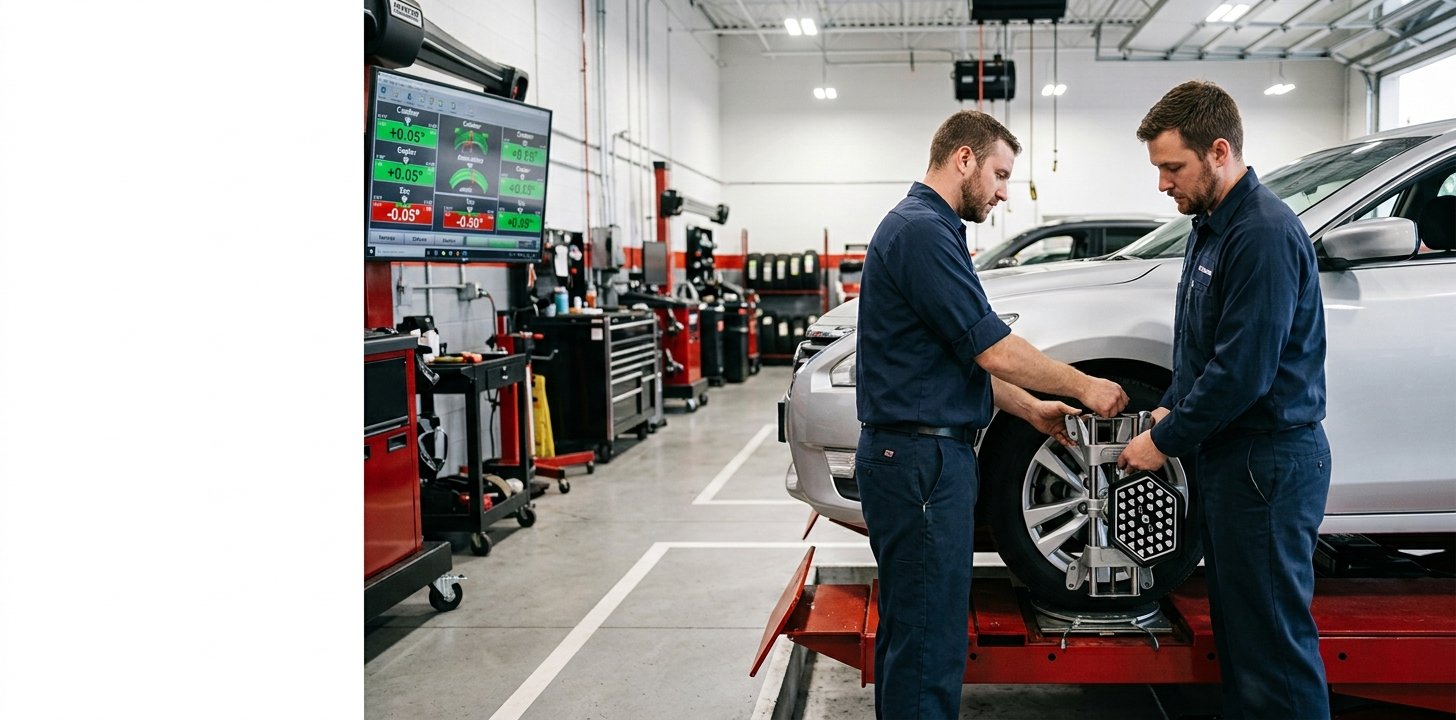
Wheel alignment is one of those maintenance items that's easy to ignore — until your tires wear unevenly and you're replacing them two years early. A proper alignment keeps your wheels pointing the right direction, protects your tire investment, and improves fuel economy.
Here's exactly what an alignment should cost in the US in 2026, why two shops can quote you $70 and $180 for the same job, and how to know if you even need one.
How Much Does a Wheel Alignment Cost in 2026?
A wheel alignment costs $80 to $200 in the US in 2026, depending on whether you need a front-end or four-wheel alignment. The national average for a four-wheel alignment is $130 to $200. Front-end alignments run $80 to $130.
The spread comes down to three things: how many wheels need adjusting, how complex your vehicle's suspension is, and where you get the work done. A simple front-end alignment on a Honda Civic takes 30 minutes. A four-wheel alignment on an all-wheel-drive BMW with adaptive suspension can take 90 minutes and require specialized equipment.
Front-End vs. Four-Wheel Alignment: The Critical Difference
This is the single most important distinction in alignment pricing — and the one most drivers don't understand.
| Alignment Type | 2026 US Price | Best For | Time |
|---|---|---|---|
| Front-End (Two-Wheel) | $80 – $130 | Vehicles with solid rear axles (older trucks, some vans) | 30 – 45 min |
| Four-Wheel | $130 – $200 | Most modern cars, SUVs, AWD, independent rear suspension | 60 – 90 min |
| Thrust Angle | $50 – $80 | Vehicles with fixed rear axles where rear angles can't be adjusted | 30 – 45 min |
| Dealership (4-wheel) | $150 – $250+ | Luxury, European, or warranty-sensitive vehicles | 60 – 120 min |
The technical difference: A front-end alignment adjusts only the front wheels' toe, camber, and caster. A four-wheel alignment adjusts all four wheels and ensures the rear wheels are aligned to the vehicle's centerline before the front wheels are set. Without that rear reference point, the front alignment can be "correct" while the car still drives crooked.
Cost by Vehicle Type
Larger, heavier, or more complex vehicles require more time and specialized equipment. Here's the 2026 pricing by category:
| Vehicle Type | Typical Price Range | Notes |
|---|---|---|
| Compact / Midsize Sedan | $100 – $150 | Honda Civic, Toyota Camry, Hyundai Elantra. Simple independent suspension. |
| SUV / Crossover | $120 – $180 | Toyota RAV4, Honda CR-V, Ford Explorer. Slightly more complex rear geometry. |
| Full-Size Truck | $130 – $200 | Ford F-150, Chevy Silverado. Heavier wheels, more adjustment points. |
| Luxury / European | $180 – $300+ | BMW, Mercedes, Audi. Complex geometry, ADAS calibration may be required. |
| EV (Tesla, Mach-E, Ioniq) | $150 – $250 | Heavier battery weight, ADAS systems. Some chains charge more for EVs. |
| Lifted Truck / 4x4 | $150 – $250+ | Custom suspension geometry. Factory specs may not apply. |
Cost by Shop (2026 US Prices)
Where you get your alignment done changes the price significantly. Here's how the major US chains and shop types compare:
| Shop | Standard Alignment | Lifetime Plan | Notes |
|---|---|---|---|
| Independent Shop | $100 – $150 | Varies | Best value. Ask for a printout of before/after specs. |
| Firestone | $100 – $130 | $220 – $250 | Lifetime plan pays off after 2 visits. Watch for upsells on worn parts.[citation:2] |
| Discount Tire / America's Tire | $90 – $200 | Not offered | Free alignment check with tire install. $89.99 most makes, $199.99 EVs.[citation:3][citation:4] |
| Pep Boys / Mavis | $110 – $180 | Varies | Often runs coupons. Mavis reported at ~$180 for some vehicles.[citation:13] |
| Dealership | $150 – $250+ | Rarely offered | Most expensive. Uses factory-trained techs and OEM specs. |
The Firestone Lifetime Alignment Math
Firestone's Lifetime Alignment is the most well-known "unlimited" alignment plan in the US. Here's how the math actually works:
| Plan Type | Year 1 Cost | Year 2 Cost | Year 3 Cost | Year 4 Cost | Year 5 Cost | Total 5-Year |
|---|---|---|---|---|---|---|
| Pay-Per-Visit (1x/year) | $110 | $110 | $110 | $110 | $110 | $550 |
| Lifetime Alignment | $220 | $0 | $0 | $0 | $0 | $220 |
Breakeven point: 2 visits. At $110 per standard alignment and $220 for the lifetime plan, the plan pays for itself the second time you use it. If you keep the car for 5 years and get aligned annually, you save $330.[citation:2]
- The plan is tied to the vehicle's VIN — you can't transfer it to your next car.
- If worn parts (tie rods, ball joints) prevent alignment, repairs are extra.
- Some locations have mixed service quality. Check local reviews before buying.[citation:9]
Signs Your Car Needs an Alignment
Don't wait for your tires to show damage. These 5 signs mean it's time:
- Steering wheel is off-center. When driving straight, the steering wheel should be centered. If it's tilted left or right, the toe angle is off.
- Car pulls to one side. On a flat road with no wind, the car should track straight. Consistent pulling means camber or caster is out of spec.
- Uneven or rapid tire wear. Feathering (smooth on one side, sharp on the other), edge wear, or center wear all point to alignment issues.
- Vibrating steering wheel. While often a balance issue, alignment can also cause vibration at highway speeds.
- Tires squealing on normal corners. If your tires protest at moderate speeds, they're fighting misaligned angles.
What Causes Misalignment
- Potholes and rough roads. The #1 cause. A significant impact can knock alignment out instantly.
- Hitting curbs. Even at parking lot speeds, a curb strike can bend tie rod ends or shift subframe alignment.
- Worn suspension components. Tie rod ends, ball joints, and control arm bushings wear out over time. Once they develop play, alignment can't hold.
- Normal wear. Even without impacts, alignment gradually drifts over 12,000+ miles.
- After suspension work. Replacing struts, control arms, or tie rods requires a new alignment.
- New tires. Not a cause, but the best time to align — protects your new tire investment.
How Often Should You Get an Alignment?
The general US guidance is every 6,000 to 10,000 miles — or once per year, whichever comes first. But the right answer depends on your situation:
| Situation | Recommended Frequency |
|---|---|
| Normal driving, smooth roads | Every 12,000 – 15,000 miles or annually |
| Rough roads / pothole-heavy areas | Every 6,000 – 8,000 miles |
| After hitting a major pothole or curb | Immediately |
| After suspension repairs | Immediately after the repair |
| When buying new tires | At the same time as installation |
| Lifetime alignment plan holders | Every 6,000 miles or 6 months (per plan terms) |
If you're checking tire pressure regularly, add a quick alignment check to your rotation routine. See our tire pressure guide for the 5-minute monthly check that pairs with this maintenance.
ADAS Calibration: The Modern Car's Alignment Tax
If your car was built in 2018 or later, it almost certainly has Advanced Driver Assistance Systems (ADAS) — lane-keeping assist, adaptive cruise control, automatic emergency braking, or blind-spot monitoring. These systems rely on forward-facing cameras and radar sensors mounted to the windshield, grille, or bumper.
Here's the problem: those sensors are calibrated to specific wheel alignment angles. When a shop changes your camber, caster, or toe, the sensors are now pointing at slightly the wrong spot. The difference is often less than a degree — but it's enough to make lane-keeping drift, adaptive cruise misjudge following distance, or automatic braking react late.
- Your safety systems may not work correctly in an emergency
- Some manufacturers require calibration to maintain warranty coverage
- A "Check Forward Collision" or "Lane Departure Unavailable" warning light may appear
- On some vehicles, the ADAS system will disable itself entirely until recalibrated
Cost: ADAS calibration runs $150 to $400 on top of the alignment itself. Some shops bundle it into the alignment price; most charge separately. Not every shop has the equipment — you may need to go to a dealership or specialty shop for this step.
| Calibration Type | Typical US Price | What It Covers |
|---|---|---|
| Static (target-based) | $150 – $300 | Vehicle parked in front of physical targets. Common on Asian and domestic brands. |
| Dynamic (road test) | $100 – $250 | Vehicle driven at specific speeds on marked roads. Faster but requires ideal conditions. |
| Combined (static + dynamic) | $250 – $400 | Some European brands (BMW, Mercedes, Audi) require both. Most expensive. |
Which vehicles need it? Almost all 2018+ vehicles with ADAS. Specific examples: Tesla (all models), Ford (Co-Pilot360 equipped), Toyota (Toyota Safety Sense 2.0+), Honda (Honda Sensing), Subaru (EyeSight), BMW (all with Driving Assistance), Mercedes (all with Active Distance Assist).
Ask before you book: "Does my car require ADAS calibration after alignment?" If the shop says no and your car is a 2018+ model with driver-assist features, get a second opinion — they may not have the equipment to do it.
5 Mistakes to Avoid
- Buying a front-end alignment for a modern car. Most cars built after 2010 need a four-wheel alignment. A front-end job leaves the rear misaligned.
- Not getting a printout. A reputable shop will give you a before/after printout showing camber, caster, and toe readings. If they won't provide one, go elsewhere.
- Aligning before replacing worn parts. If your tie rods are shot, the alignment won't hold. Fix the worn parts first, then align.
- Skipping the alignment after new tires. New tires are $600–$1,200. A $150 alignment protects that investment.
- Ignoring ADAS calibration on modern cars. If you drive a 2018+ vehicle, ask if calibration is required. Some shops skip it because they don't have the equipment.
The Bottom Line
For most US drivers, a four-wheel alignment costs $130–$200 at an independent shop or tire chain in 2026. Front-end alignments run $80–$130 but are only appropriate for vehicles with solid rear axles. Dealerships charge $150–$250+ for the same service.
If you plan to keep your car for 2+ years, the Firestone Lifetime Alignment at ~$220 pays for itself after the second visit. If you're buying new tires, get the alignment at the same time — it protects your tire investment and takes less than 90 minutes.
For related tire maintenance, see our tire pressure guide and tire change tutorial. If you're buying new tires, our tire pressure gauge review helps you keep them properly inflated.
Frequently Asked Questions (US)
How much does a full alignment cost?
A full four-wheel alignment costs $130 to $200 for most US passenger vehicles in 2026. Front-end (two-wheel) alignments run $80–$130. Dealerships typically charge $150–$250+ for the same service.
Is $100 a lot for an alignment?
No — $100 is a fair price for a front-end alignment and on the low end for a four-wheel alignment. The national average for a four-wheel alignment is around $150. If you're quoted $100 for a four-wheel alignment on a modern car, that's a good deal.
How long does a full alignment take?
A standard four-wheel alignment takes 60 to 90 minutes. Front-end alignments take 30–45 minutes. Lifted trucks, luxury cars with ADAS, or vehicles with rusted bolts can take 90+ minutes. Leave the car for 2–3 hours to account for wait time.
Do you have to pay for wheel alignment?
Yes, the adjustment is always a paid service. However, Discount Tire and America's Tire offer free alignment checks (measuring the angles) with tire installation. The adjustment itself costs $90–$200 depending on the vehicle.
Is it worth paying for wheel alignment?
Yes, if you have symptoms (pulling, uneven tire wear, off-center steering) or it's been over 12,000 miles since your last alignment. Misalignment wears tires up to 25% faster — a $150 alignment can save you $600+ on premature tire replacement.
How much does Firestone charge for an alignment?
Firestone charges $99.99 to $129.99 for a standard alignment. Their Lifetime Alignment plan costs around $219.99 and covers alignments for as long as you own the vehicle. Check Firestone's website for coupons before booking.[citation:2]
How much does Discount Tire charge for an alignment?
Discount Tire charges around $90 to $200 for a wheel alignment. America's Tire (their California brand) charges $89.99 for most makes and $199.99 for EVs. Both offer free alignment inspections with tire installation.[citation:3]
How often should you get a wheel alignment?
Every 6,000 to 10,000 miles, or once per year — whichever comes first. Also get one after hitting a major pothole, curb, or being in an accident. If you buy new tires, get an alignment at the same time.