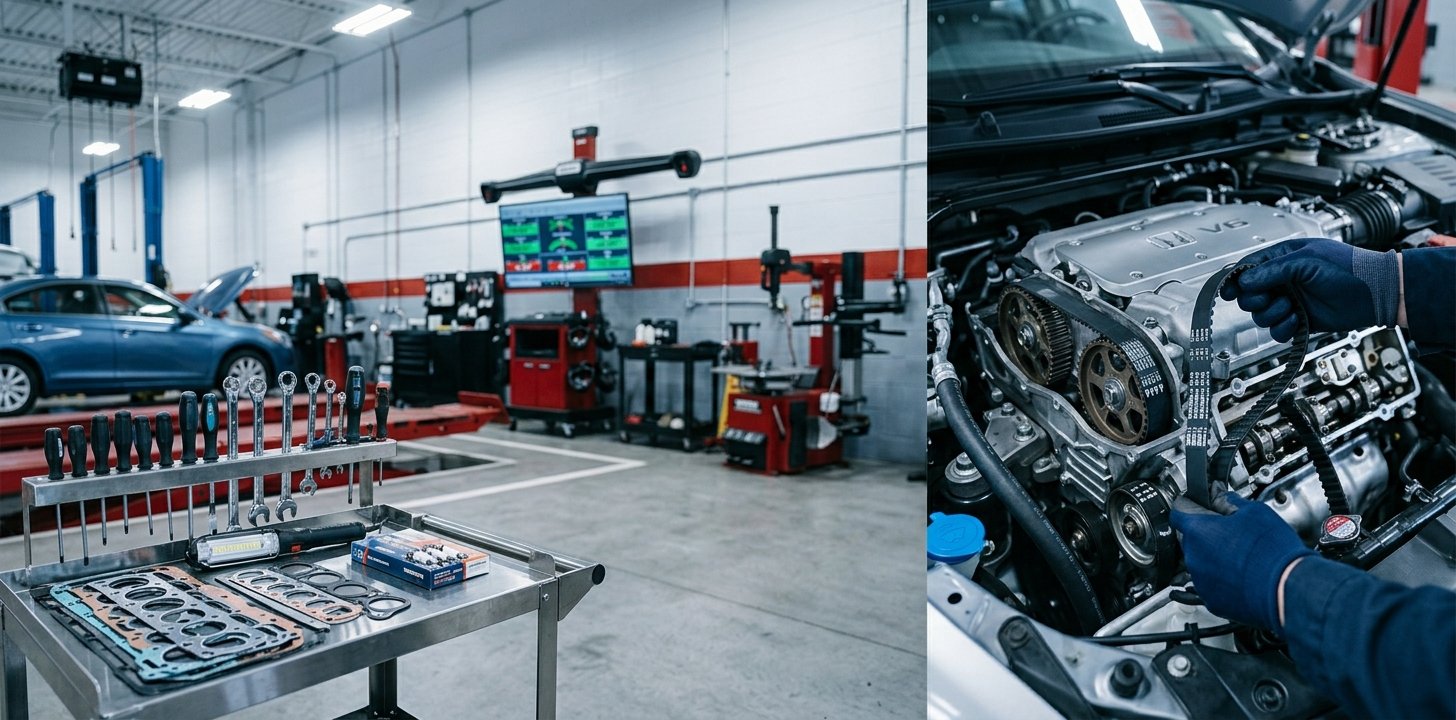
The timing belt is the single most critical maintenance item on any car that has one. It's a rubber belt that synchronizes the engine's crankshaft and camshaft — and if it breaks while you're driving, the pistons can slam into the valves, destroying the engine in a fraction of a second.
Here's exactly what a timing belt replacement should cost in the US in 2026, why bundling it with the water pump is almost always smart, and the warning signs that mean you shouldn't delay.
How Much Does a Timing Belt Replacement Cost in 2026?
A timing belt replacement costs $500 to $1,500 in the US in 2026, with a national average of $700–$900 for most vehicles. Honda and Toyota 4-cylinders run $500–$800. V6 engines, luxury cars, and jobs bundled with a water pump cost $900–$1,500.
The spread comes down to three things: how hard it is to reach the timing belt (engine layout matters enormously), how many supporting parts get replaced at the same time, and whether you use an independent shop or a dealership.
| Service | Parts | Labor | Total |
|---|---|---|---|
| Belt only (rare) | $40 – $120 | $400 – $700 | $440 – $820 |
| Belt + tensioner + idler | $150 – $300 | $400 – $700 | $550 – $1,000 |
| Full kit + water pump | $250 – $500 | $450 – $800 | $700 – $1,300 |
| Luxury / European | $400 – $800 | $500 – $900 | $900 – $1,700 |
Cost by Popular US Vehicle (2026)
Timing belt pricing varies significantly by engine layout. Here's what US drivers actually pay for the most common vehicles with timing belts:
| Vehicle | Typical Cost (Belt + Water Pump) | Notes |
|---|---|---|
| Honda Civic (1.8L) | $500 – $700 | Only 2006–2015 models have belts. 2016+ use chains. |
| Honda Accord (V6) | $900 – $1,200 | Transverse V6 — difficult access. Worth bundling seals. |
| Honda Odyssey (3.5L V6) | $900 – $1,300 | One of the most common timing belt jobs in the US. Every 105,000 miles. |
| Honda Pilot (3.5L V6) | $900 – $1,300 | Same V6 as Odyssey. Similar pricing. |
| Acura MDX (3.5L V6) | $950 – $1,400 | Dealerships charge closer to $1,400. |
| Toyota Camry (V6, pre-2018) | $800 – $1,100 | 90,000-mile interval. 2018+ V6 uses a chain. |
| Subaru (2.5L, pre-2011) | $800 – $1,200 | 105,000-mile interval. Boxer engine layout adds labor. |
| Mitsubishi 4-cylinder | $600 – $900 | Simpler FWD layout, cheaper labor. |
What's Included in a Timing Belt Service
A "timing belt replacement" means different things at different shops. Here's what should be included in a complete service — and what some shops charge extra for:
| Component | Typical Part Cost | Replace? |
|---|---|---|
| Timing belt | $40 – $120 | Always |
| Tensioner | $40 – $80 | Always |
| Idler pulley | $30 – $70 | Always |
| Water pump | $60 – $150 | Recommended (belt drives it) |
| Camshaft / crankshaft seals | $15 – $40 each | Recommended |
| Serpentine belt | $25 – $60 | Optional (if worn) |
| Coolant | $25 – $60 | Required (if water pump replaced) |
Timing Belt + Water Pump: Why You Should Bundle Them
On most engines with timing belts, the water pump is driven by the timing belt. That means any time the belt is being replaced, the water pump is already exposed and accessible — replacing it later means paying for the same labor twice.
| Approach | Cost | Notes |
|---|---|---|
| Belt + water pump together | $900 – $1,300 | Best value. One labor charge. |
| Belt now, water pump later | $700 + $600 = $1,300 | Pay labor twice. Worse deal overall. |
| Water pump fails on its own | $500 – $800 | Often happens 20K–40K miles after belt replacement. |
Cost by Shop Type (2026 US Prices)
Where you get the work done matters — a lot. Here's how US shops compare for a Honda Odyssey timing belt service (belt + water pump):
| Shop | Typical Cost | Notes |
|---|---|---|
| Independent Shop | $850 – $1,100 | Best value. Ask for OEM or premium aftermarket parts. |
| Firestone / Midas | $1,000 – $1,300 | National chain. Look for coupons before booking. |
| Honda / Toyota Specialist | $900 – $1,200 | Best for Honda and Toyota owners. Knows the exact intervals and quirks. |
| Dealership | $1,200 – $1,600 | Most expensive. Uses OEM parts and factory procedures. |
Symptoms of a Failing Timing Belt
Timing belts rarely fail without warning. Watch for these signs:
- Visible cracks or fraying. If you can inspect the belt (some engines have an inspection cover), look for cracks, glazing, or frayed edges. Replace immediately.
- Chirping or squealing sound. A worn tensioner or idler can produce a high-pitched noise from the front of the engine.
- Rough idling or misfires. If the belt is slipping, the camshaft timing drifts, causing rough running or misfire codes (P0011, P0016, P0300).
- Oil leaks around the timing cover. Camshaft or crankshaft seal failure contaminates the belt and accelerates wear.
- Coolant leaks near the water pump. On engines where the water pump is timing-belt-driven, a leaking pump is a warning sign to inspect the belt.
What Happens If the Timing Belt Breaks
This is the section that makes timing belt replacement urgent. Two scenarios exist, depending on whether your engine is an interference or non-interference design:
⚠️ Interference Engine
$2,500 – $4,500+
- Pistons and valves occupy the same space at different times
- Belt breaks → pistons strike open valves → bent valves
- Often damages cylinder head, pistons, and valve guides
- Repair requires cylinder head rebuild or full engine replacement
- Most modern cars (Honda, Toyota, Subaru) are interference
✅ Non-Interference Engine
$700 – $1,000
- Pistons and valves never occupy the same space
- Belt breaks → engine stops → no internal damage
- Car won't start (needs tow) but engine is repairable
- Repair is the same as a scheduled replacement
- Less common on modern vehicles — mostly older designs
Timing Belt vs. Timing Chain
Modern engines are increasingly switching to timing chains, which don't require scheduled replacement. Here's how the two compare:
| Factor | Timing Belt | Timing Chain |
|---|---|---|
| Replacement interval | Every 60K – 105K miles | Lifetime (usually) |
| Replacement cost | $500 – $1,500 | $1,500 – $3,000+ (if ever) |
| Noise | Quiet | Slight whine or rattle when worn |
| Failure risk | Sudden failure possible | Rarely fails without warning |
| Common on | Most pre-2015 engines | Most 2015+ engines |
| Maintenance | Required every 90K miles | None (in theory) |
How to tell which one you have: Check your owner's manual under the maintenance schedule. If there's a "replace timing belt" interval listed, you have a belt. If not, you likely have a chain.
Replacement Intervals by Manufacturer
Always follow your owner's manual above any general guidance. But here are the common intervals for the most popular US brands:
| Manufacturer | Typical Interval | Notes |
|---|---|---|
| Honda / Acura | 90,000 – 105,000 miles | Most V6 engines. Some also recommend 7-year max regardless of mileage. |
| Toyota / Lexus | 90,000 miles | Older V6 engines. 2018+ V6 models use chains instead. |
| Subaru | 105,000 miles | Boxer engines. Manual transmission models may differ. |
| Mitsubishi | 60,000 – 90,000 miles | Older 4-cylinders. Shorter intervals than most competitors. |
| Hyundai / Kia | 60,000 – 90,000 miles | Early intervals shorter. Most 2015+ models use chains. |
| Ford (some models) | 105,000 – 150,000 miles | Varies widely by engine. Check manual — Ford is inconsistent. |
| Volkswagen / Audi | 80,000 – 120,000 miles | Varies by engine. Some 2.0T engines use chains. |
If in doubt: 90,000 miles. That's the safe middle-ground interval for most belt-driven engines.
DIY vs. Shop Timing Belt Replacement
Here's the honest truth: this is not a beginner DIY job. Unlike an oil change or brake pads, a timing belt replacement requires precise timing — one tooth off and the engine won't run correctly or will destroy itself.
🛠️ DIY Timing Belt
$200 – $500 (parts)
- ✅ Saves $400–$800 in labor
- ✅ Takes 4–8 hours (first-timer)
- ✅ Needs timing tools, torque wrench, jack stands
- ⚠️ One wrong tooth = catastrophic engine damage
- ⚠️ No warranty if you get it wrong
- ⚠️ Not recommended for beginners
🔧 US Shop Timing Belt
$700 – $1,300
- ✅ Warranty on both parts and labor
- ✅ Correct timing guaranteed
- ✅ Same-day turnaround usually
- ✅ Includes water pump and seals if requested
- ⚠️ Costs 2–3× the DIY parts price
5 Timing Belt Mistakes to Avoid
- Replacing only the belt. The tensioner and idler pulley wear at the same rate. Skipping them means the new belt fails early — often within 10,000 miles.
- Skipping the water pump. On belt-driven water pumps, replacing the belt without the pump costs you a second labor charge down the road. Always bundle.
- Ignoring the age limit. Timing belts degrade with age, not just mileage. If your belt is 7–10 years old — even with low miles — replace it. Rubber dry-rots.
- Buying a cheap aftermarket belt. OEM or premium aftermarket (Gates, Dayco, Aisin) belts cost $20–$40 more than the cheapest option but last dramatically longer. Worth every dollar.
- Waiting past the interval. Every mile past the manufacturer's recommendation increases the failure risk. A $1,000 preventive service is nothing compared to a $4,000 engine rebuild.
The Bottom Line
A complete timing belt service (belt, tensioner, idler, water pump) costs $700–$1,300 at an independent US shop in 2026, or $1,200–$1,600 at a dealership. If your vehicle is within 10,000 miles of its recommended interval — or the belt is 7+ years old — don't wait.
For Honda V6 owners (Odyssey, Pilot, Accord), plan on $900–$1,300 every 105,000 miles. For Subaru and Toyota owners, similar ranges every 90,000–105,000 miles. The alternative is a $2,500–$4,500 engine repair if the belt breaks.
For related engine maintenance, see our oil change cost guide and check engine light guide. If you're also due for a wheel alignment, our alignment cost guide covers what to pay.
Frequently Asked Questions (US)
How much does a timing belt replacement cost in 2026?
Timing belt replacement costs $500 to $1,500 in the US in 2026, with a national average of $700–$900. Honda and Toyota 4-cylinders run $500–$800. V6 engines, luxury cars, and jobs bundled with a water pump cost $900–$1,500.
How much does it cost to replace a timing belt and water pump together?
Replacing the timing belt and water pump together costs $900 to $1,500 in the US. Since the water pump is driven by the timing belt on most vehicles, bundling saves you the labor cost of a separate water pump replacement ($400–$800).
What happens if a timing belt breaks while driving?
On an interference engine (most modern cars), a broken belt causes pistons to strike valves, bending them and often damaging the cylinder head. Repairs jump to $2,500–$4,500+. This is why timing belt replacement is preventive, not reactive.
How long does a timing belt replacement take?
3 to 6 hours of shop labor. Honda and Toyota 4-cylinders take 3–4 hours. V6 engines and transverse-mounted engines take 5–6 hours. Most shops complete the job in a single day.
Is timing belt replacement worth it on an old car?
If the car is otherwise in good condition and you plan to keep it 2+ years, yes. A $700–$1,000 timing belt service protects against a $3,000–$4,500 engine repair. If the car is worth under $3,000 or has other major issues, the math gets harder.
How often should a timing belt be replaced?
Every 60,000 to 105,000 miles, or every 6 to 10 years — whichever comes first. Honda is typically 90,000–105,000 miles. Toyota is 90,000. Subaru is 105,000. Always check your owner's manual.
Does my car have a timing belt or a timing chain?
Timing belts are common on 4-cylinder and V6 engines built before 2015. Timing chains are more common on 2015+ engines and typically last the life of the vehicle. Check your owner's manual — if there's a "replace timing belt" interval listed, you have a belt.
What's included in a timing belt replacement service?
A complete service includes the timing belt, tensioner, idler pulley, and often the water pump and camshaft/crankshaft seals. Ask for a written itemized quote — if a shop quotes only the belt itself, they may be skipping parts that matter.