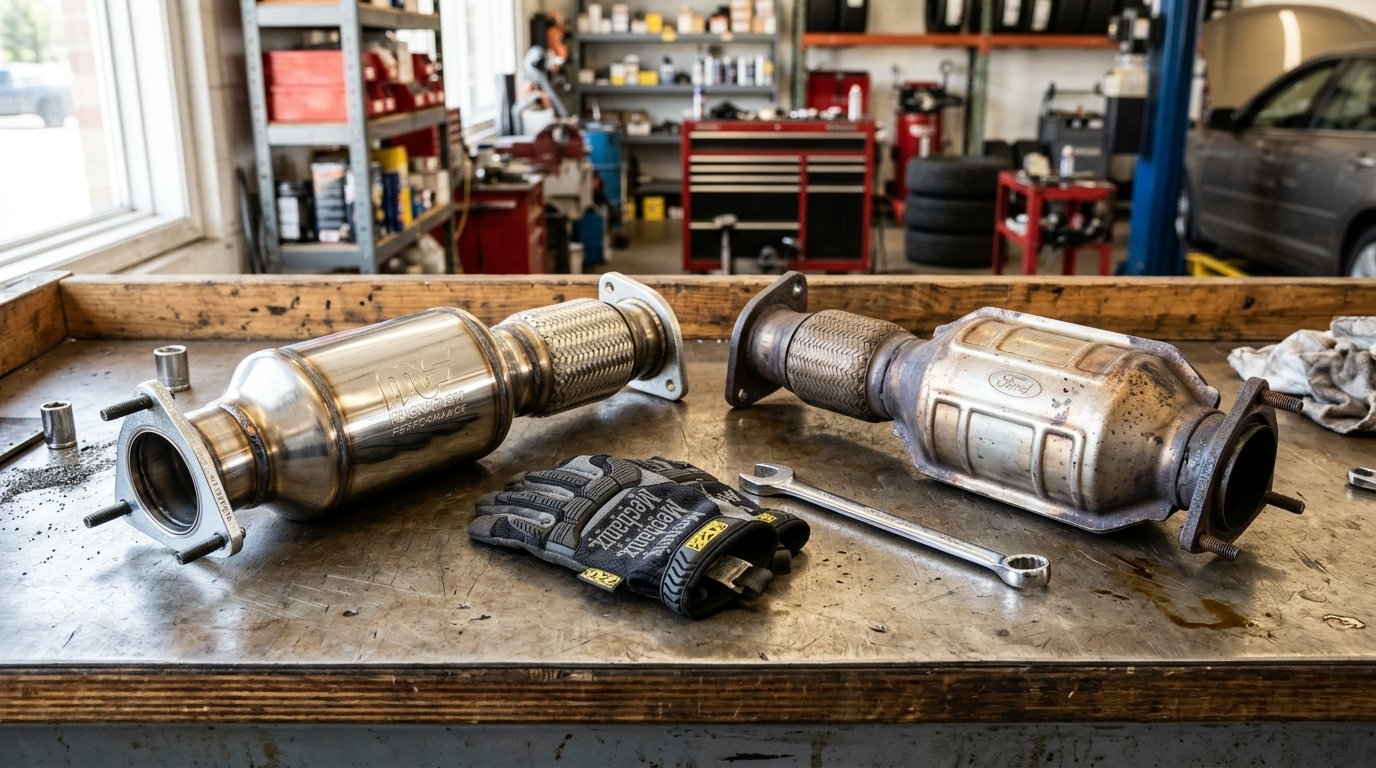
If your catalytic converter failed or was stolen, you have a decision to make. You can buy a cheap $150 universal converter, a $600 direct-fit from MagnaFlow, or a $2,000 OEM part from the dealership.
Choosing the wrong one can cost you twice—once when you buy it, and again when it fails your state's emissions test. Here is the breakdown.
The 3 Types of Converters
| Type | Typical Cost | Pros | Cons |
|---|---|---|---|
| Universal | $100 – $300 | Cheapest option | Requires welding; often fails emissions |
| Direct-Fit Aftermarket | $250 – $800 | Bolt-on (no welding); good warranty (MagnaFlow) | Not legal in CA/NY/CO |
| OEM (Dealer) | $800 – $2,500+ | Perfect fit; guaranteed to pass emissions | Extremely expensive |
Universal converters are a one-size-fits-all cylinder. A muffler shop has to cut your exhaust pipe and weld it in. They are cheap, but the internal honeycomb often lacks sufficient precious metals to keep the check engine light off long-term.
Direct-fit converters (like MagnaFlow) are pre-bent to match your exact vehicle. They bolt right up to the factory flanges and include the O2 sensor ports. This is the best option for most US drivers.
CARB vs. EPA Compliance: The Most Important Rule
This is where most people make a $1,000 mistake. Not all converters are legal in all states.
- EPA Compliant (Federal): Legal in 49 states. This is the standard "aftermarket" converter.
- CARB Compliant (California): Required if you live in California, New York, Maine, or Colorado. CARB (California Air Resources Board) converters use more precious metals to meet stricter emissions standards. They cost 2x–3x more than an EPA converter.
Are MagnaFlow Catalytic Converters Good?
Yes. MagnaFlow is one of the most searched and trusted aftermarket brands in the US. They offer a direct-fit series that is a massive step up from a generic universal converter.
Why we recommend MagnaFlow:
- Bolt-on installation (no welding required)
- Stainless steel construction (resists rust)
- Good balance of price ($300–$800) and reliability
- They offer both EPA-compliant and CARB-compliant versions (make sure you buy the right one)
Why Cheap Catalytic Converters Fail
You can find a $100 converter on Amazon or eBay. Here is why a professional mechanic will usually refuse to install it:
- They lack precious metals: The reason a converter works is the platinum and rhodium coating. Cheap ones use the bare minimum. The check engine light (P0420) often returns within 10,000 miles.
- Poor fitment: Universal cats require cutting your factory exhaust. If the weld is bad, it will leak, which messes up the O2 sensor readings.
- Warranty issues: Most cheap brands offer a 1-year warranty that is difficult to claim. MagnaFlow and OEM offer 5-year/50,000-mile warranties or better.
If you are replacing a converter because it was stolen, do not buy a cheap one—it will just get stolen again. Protect it with a catalytic converter shield.
The Bottom Line
For most US drivers, a direct-fit aftermarket (like MagnaFlow) is the sweet spot. It bolts right on, costs $250–$800, and will pass emissions in 49 states.
If you live in California, New York, Maine, or Colorado, you must buy a CARB-compliant converter.
For the full breakdown of what a shop will charge you for the part and labor, see our Catalytic Converter Replacement Cost guide.
Frequently Asked Questions (US)
What is the difference between a universal and a direct-fit catalytic converter?
A universal converter is a generic part that requires cutting and welding the exhaust pipe to fit. A direct-fit converter is bolt-on, pre-bent to match the exact dimensions of your specific vehicle, and includes the necessary flanges and O2 sensor bungs.
Will a cheap aftermarket catalytic converter pass emissions?
It depends on your state. In 49 states, a standard EPA-compliant converter will usually pass. However, if you live in California, New York, Maine, or Colorado, you MUST use a CARB-compliant converter.
Are MagnaFlow catalytic converters good?
Yes. MagnaFlow is one of the most trusted aftermarket brands in the US. Their direct-fit converters are high quality, use good precious metals, and offer a solid warranty.
Why are OEM catalytic converters so expensive?
OEM (Original Equipment Manufacturer) converters are made by the same company that built your car. They use higher concentrations of precious metals to guarantee they meet the strictest emissions standards for the life of the vehicle.