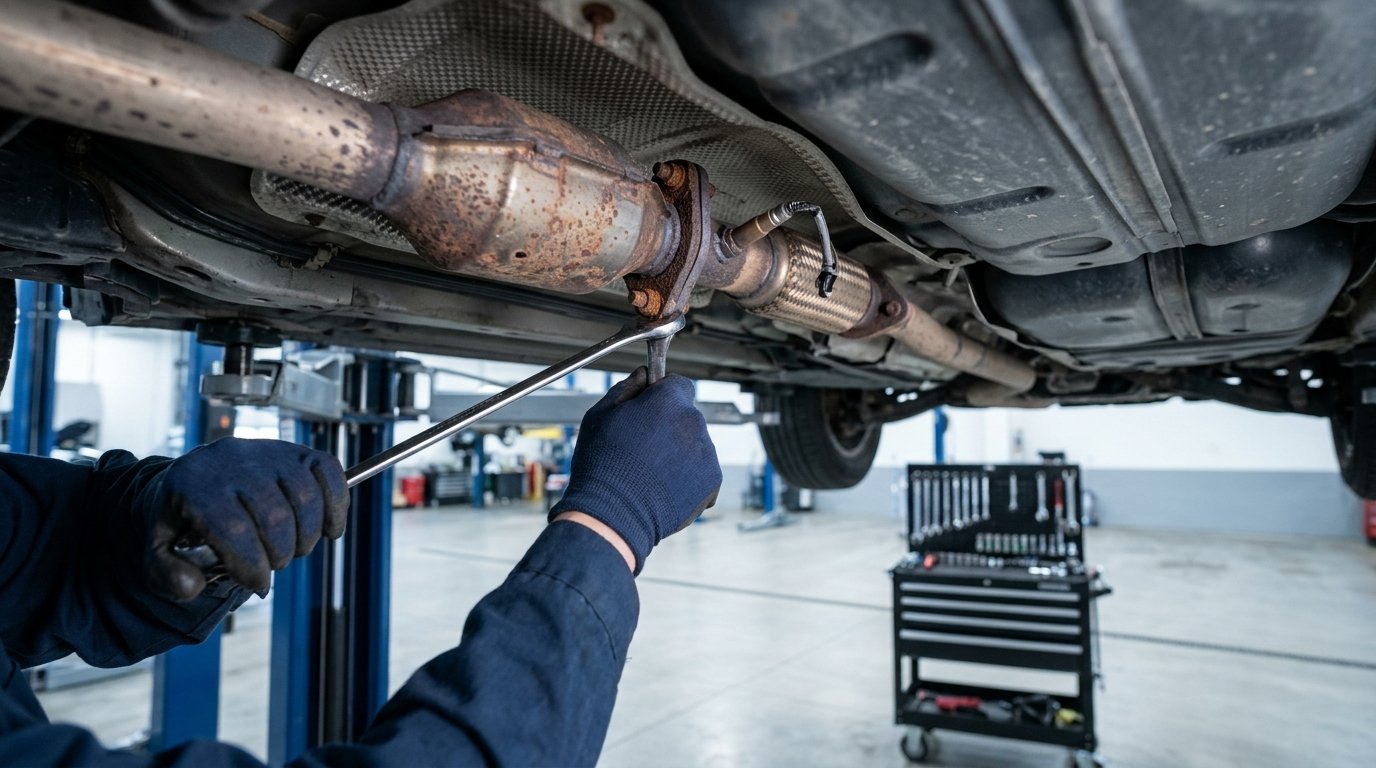
The catalytic converter is one of the most expensive emissions components on your vehicle. When it fails, it's not just a check-engine light — it's a repair bill that can easily exceed $2,500.
Here's exactly what a catalytic converter costs to replace in the US in 2026, why prices are so high, and what to do if yours is failing, throwing a P0420 code, or was stolen.
How Much Does a Catalytic Converter Cost in 2026?
A catalytic converter replacement costs $1,000 to $3,500 in the US in 2026. The national average is $1,500–$2,500. Standard 4-cylinder cars run $1,000–$1,500, while V6 and V8 trucks cost $1,500–$2,500. Luxury and hybrid vehicles with multiple converters can exceed $5,000.
The price depends on three main factors: the cost of the converter itself (which varies wildly based on the precious metals inside), the labor to remove the old one (which is often rusted and seized), and whether you choose an OEM or aftermarket part.
| Vehicle Type | Parts | Labor | Total |
|---|---|---|---|
| 4-Cylinder Sedan | $600 – $1,200 | $150 – $300 | $750 – $1,500 |
| V6 Sedan / Minivan | $800 – $1,800 | $200 – $400 | $1,000 – $2,200 |
| V8 Truck / SUV | $1,000 – $2,500 | $250 – $500 | $1,250 – $3,000 |
| California Emissions (CARB) | $1,200 – $2,800 | $200 – $500 | $1,400 – $3,300+ |
Why Is a Catalytic Converter So Expensive?
There's a reason a catalytic converter costs more than a new transmission: the materials inside are among the most expensive on earth.
Catalytic converters use precious metals as catalysts. Platinum, palladium, and rhodium are used to convert toxic carbon monoxide, hydrocarbons, and nitrogen oxides into less harmful gases. Rhodium, in particular, can cost over $10,000 per ounce.
- Precious metals: The core contains a ceramic honeycomb coated with platinum, palladium, and rhodium.
- Multiple units: Many V6 and V8 engines use two, three, or even four converters (one per cylinder bank).
- CARB compliance: Vehicles sold in California (and states that follow its rules) require CARB-compliant converters, which are significantly more expensive than federal-spec units.
- Labor: Exhaust bolts are notoriously rusty. What looks like a 1-hour job can take 3 hours if the bolts snap.
Catalytic Converter Cost by Popular US Model
Pricing varies significantly by vehicle. Here's what you can expect to pay for the most common US models in 2026. Note that Toyota, Ford, and Honda models dominate the search volume and repair frequency in the US.
| Vehicle | Typical Cost | Notes |
|---|---|---|
| Honda Accord (4-cyl) | $1,000 – $1,600 | Common repair. One converter. |
| Honda CR-V | $1,100 – $1,700 | Manifold-mounted converter. |
| Toyota Camry (4-cyl) | $1,000 – $1,800 | One converter. |
| Toyota Prius | $1,500 – $2,800 | High theft target. Often stolen. Requires special exhaust work. |
| Toyota Tacoma (V6) | $1,500 – $2,600 | Dual converters. Highly stolen. |
| Ford F-150 (V6 / V8) | $1,500 – $2,500 | Dual converters. Higher part cost. |
| Honda Odyssey (V6) | $1,200 – $2,200 | Common repair. Often needs rear converter. |
| Chevy Equinox (4-cyl) | $900 – $1,500 | Frequent failure point for this model. |
P0420 Code: Does It Mean You Need a New Converter?
The most common code associated with a catalytic converter is P0420 ("Catalyst System Efficiency Below Threshold"). If you see this code, don't authorize a $2,000 repair immediately.
Here are the three most common causes of a P0420 code:
- Bad Downstream O2 Sensor ($150–$400): The sensor measuring the converter's efficiency might be faulty, triggering a false positive.
- Exhaust Leak ($100–$300): A leak before the converter lets in oxygen, tricking the sensor into thinking the converter isn't working.
- Failing Catalytic Converter ($1,000+): The honeycomb is actually degraded or melted.
The Stolen Converter Epidemic
Catalytic converter theft has skyrocketed in the US over the past few years. Thieves slide under the car with a saw, cut the converter out in 60 seconds, and sell it to a scrap yard for $200–$1,000 due to the precious metals inside. Trucks, SUVs, and hybrids (especially the Prius and Tacoma) are prime targets because they sit higher off the ground.
Cost to replace a stolen converter: Same as a regular replacement — $1,000–$3,000. However, thieves often cut through the exhaust pipes and O2 sensor wires, which adds $200–$500 in extra repairs.
How to prevent theft:
- Install a skid plate or shield: $150–$400, installed at most shops. Stainless steel is the most effective. See our best catalytic converter shields guide for top recommendations.
- Park in a garage or well-lit area. Avoid parking low-clearance cars on the street.
- Etch your VIN onto the converter. Some shops offer this, and it makes it harder to sell to a scrap yard.
What is a "Cadillac Converter"? (The Common Misspelling)
If you're searching for a "Cadillac converter" and getting confused by the results, you're not alone. It is one of the most common misspellings of catalytic converter.
A "Cadillac converter" has absolutely nothing to do with Cadillac vehicles. It is simply an emissions control device installed on almost every car. The cost to replace a "Cadillac converter" is exactly the same as a catalytic converter: $1,000 to $3,500 depending on the vehicle.
OEM vs. Aftermarket vs. Universal
The part you choose drastically changes the price. Here's the breakdown:
| Converter Type | Typical Part Cost | Best For |
|---|---|---|
| Universal Aftermarket | $100 – $300 | Older cars, budget repairs (requires welding) |
| Direct-Fit Aftermarket | $250 – $800 | Most standard repairs (e.g., MagnaFlow) |
| OEM (Dealership) | $800 – $2,500+ | Newer cars, lease returns, strict emissions states |
| CARB Compliant (California) | $1,000 – $3,000+ | Vehicles registered in CA, NY, ME, CO, etc. |
Warning about universal converters: These are cheap but often fail emissions tests. They also require cutting and welding the exhaust pipe. If you live in a state with strict emissions testing, you must use an OEM or CARB-compliant converter.
Repair vs. Replace
Can a catalytic converter be repaired? Usually, no. The internal honeycomb is coated with precious metals; once it's contaminated or melted, it's done.
However, there are two exceptions:
- The converter is fine, but the pipe is broken. A shop can weld a new flange or pipe onto the existing converter for $150–$300.
- The O2 sensor is bad. As noted above, a P0420 code doesn't always mean the converter is bad. Replacing the sensor costs $150–$400.
If the honeycomb is clogged with carbon (but not melted), a mechanic might attempt a cleaning procedure. To learn more about this, see our guide on how to clean a catalytic converter.
The "Straight Pipe" Shortcut (And Why to Avoid It)
In states without emissions testing (like many rural counties in Florida, Michigan, or Tennessee), some drivers opt to have an exhaust shop weld in a "straight pipe" where the converter used to be. This costs $100–$200, but it's a bad idea.
How to Save Money on Catalytic Converter Replacement
- Check your insurance. If it was stolen, your comprehensive policy likely covers it.
- Verify it's actually the converter. Replace the O2 sensor first ($150–$400) before committing to a $1,500 converter. Check for the P0420 code first.
- Get 3 quotes. Dealership prices for converters are brutal. Independent shops and muffler shops (like Midas or Meineke) are often 30–40% cheaper.
- Use a direct-fit aftermarket part. Unless your car requires CARB compliance, a mid-tier aftermarket part will save you $500–$1,000.
- Consider a used converter. Risky, but for older cars, a junkyard converter can cost $200–$500. (Note: illegal in some states.)
The Bottom Line
A catalytic converter replacement costs $1,000–$3,500 in the US in 2026. Standard 4-cylinder cars run $1,000–$1,500 at an independent shop, while V6 trucks and SUVs cost $1,500–$2,500. If your converter was stolen, check your comprehensive insurance first.
Before you replace it, confirm the diagnosis. A P0420 code can often be caused by a faulty oxygen sensor — a $200 fix. If you do need a converter, get 2–3 quotes from independent shops and use a direct-fit aftermarket part to save money.
For more on emissions-related repairs, see our Check Engine Light cost guide. If your car is failing emissions due to a bad converter, you should also verify your oil change schedule — old oil can clog a new converter.
Frequently Asked Questions (US)
How much does a catalytic converter cost in 2026?
Replacing a catalytic converter costs $1,000 to $3,500 at a US shop in 2026. Standard 4-cylinder cars run $1,000–$1,500. V6 and V8 trucks cost $1,500–$2,500. Luxury and hybrid vehicles with multiple converters can exceed $5,000.
Why is a catalytic converter so expensive?
Catalytic converters contain precious metals — platinum, palladium, and rhodium. Rhodium can cost over $10,000 per ounce. These materials make the part expensive. Additionally, many vehicles use multiple converters.
How much does it cost if my catalytic converter is stolen?
Replacing a stolen catalytic converter costs the same as a regular replacement: $1,000–$3,500. However, thieves often cut the exhaust pipes and O2 sensor wires, adding $200–$500. Comprehensive auto insurance typically covers it.
What is a P0420 code and does it mean I need a new converter?
P0420 means "catalyst system efficiency below threshold." While it often points to a failing converter, it can also be caused by a bad downstream oxygen (O2) sensor ($150–$400), an exhaust leak ($100–$300), or engine misfires. Always diagnose the root cause before replacing the converter.
Can I drive with a bad catalytic converter?
You can drive short distances, but it's not recommended. A clogged converter can cause severe engine damage. If you notice a loss of power or overheating, stop driving immediately.
What is a Cadillac converter?
"Cadillac converter" is a common misspelling of "catalytic converter." It has nothing to do with Cadillac vehicles. The cost to replace a "Cadillac converter" is the same: $1,000–$3,500.
Is it cheaper to use an aftermarket catalytic converter?
Aftermarket converters are cheaper ($150–$600) than OEM parts ($800–$2,500+). However, they may not last as long and might not meet California emissions standards (CARB).
How long does a catalytic converter replacement take?
Replacing a catalytic converter takes 1 to 3 hours at a US shop. Some vehicles with V6 engines or dual exhaust systems take longer due to limited access and rusted bolts.